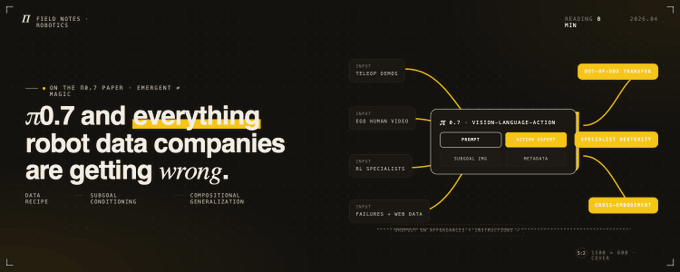
01"Emergent Capabilities" oversells it
There is a popular view that if you collect enough human ego-data and throw it at a robot, the problem is solved. You would believe it too if all you saw was a demo reel claiming hundreds of thousands of hours of human data plus an hour of task-specific data, with no word about the data engineering underneath. That framing is a competitor's marketing, not a measured result, and it is worth naming as such before we go further. Thank goodness the Physical Intelligence team put out the π0.7 paper, because it does go into the details.
A small aside on the title. "Emergent Capabilities" is overselling. Most of the gains in the paper come from specific, nameable engineering choices:
- All kinds of data, but not sim data.
- PD control loops for joint angles, and inverse kinematics for end effectors.
- Affordances over raw scale: subgoal images and subtask breakdowns do the steering.
- Dropout during training, but applied to the affordances and the instructions, not the pixels.
None of this is magic. It is a data recipe and a prompt design. This explainer walks the mechanism: why naive scaling backfires, how a single number in the metadata fixes it, and why painting one future frame does more for instruction-following than any amount of linguistic variety.
The "hundreds of thousands of hours of human data, one hour of task data" line is the author's framing of a competitor, not a number from this paper. We use it only to set up the question π0.7 actually answers, which is how to make heterogeneous data help rather than hurt.
02The architecture, plainly
π0.7 is a 5-billion-parameter vision-language-action model (VLA). Under the hood it is a 4B vision-language backbone initialized from Gemma3, which includes a 400M-parameter vision encoder, with a video-history encoder bolted on, plus a smaller action expert that turns the backbone's understanding into motor commands. Two helper models stand beside it: a world model that paints what the near future should look like, and a high-level policy that writes the next subtask in words.
The shape to hold onto: one policy network, fed a composite prompt. Everything interesting in this paper is about what goes into that prompt and how the model is trained to survive any subset of it. The sections that follow take the prompt apart one component at a time.
03All kinds of data, except sim
π0.7 uses every kind of data except simulation data. Teleoperation demos, autonomous rollouts, RL-specialist trajectories, outright failures, egocentric human video, and web data all go into the pot. That is a deliberately messy mixture, and on its own it is exactly the kind of pile that should make a model worse, not better. Conflicting strategies, uneven quality, behaviors that contradict each other.
So the heavy lifting does not happen in the data alone. It happens in the prompt. Alongside the observation, each training example carries:
- a task instruction ("clean the kitchen"),
- a subtask instruction ("pick up the knife"),
- subgoal images, the desired near-future frame for each camera,
- episode metadata: a quality score out of five, a speed tag, and a mistake flag.
Crucially, every one of these components is dropped out during training, independently and at random. The model never gets to rely on always having a subgoal image, or always having metadata. By test time it has learned to cope with any subset of the prompt, which is what lets you steer it flexibly later (section 8) and what lets it run on robots where some signals are missing.
Think of the prompt as a recipe card clipped to each demonstration. The pixels are the ingredients; the card says what dish this was meant to be, which step we are on, what the plate should look like next, and whether the cook who made it was any good. Dropout is training with some cards smudged, so the model can still cook from a partial card, and can take a more complete card as strong guidance when one is available.
04The data-quality curse: why naive scaling fails
Here is the failure that motivates the whole design. Pour in more data and a naively trained model gets worse, because the strategies inside the data disagree with each other. The paper's phrase for what goes wrong is "averaging together different behaviors." When two demonstrations of the same nominal task did contradictory things, and nothing in the input tells the model which one to trust, gradient descent splits the difference and learns the average of the two. The average of "drop the sock on the left" and "drop the sock on the right" is to drop it in the middle, which is to say nowhere useful.
Drag the dataset size below and watch the two curves diverge. Without episode metadata the model has no way to tell good strategies from bad ones, so as you add lower-quality data the average quality falls and success rises, then bends back down. That downturn is the curse: scale without context.
The shapes above are illustrative of the mechanism, not measured points. The real evidence is the paper's controlled experiment, described in the next section: the same model trained on bigger and bigger slices of data, with and without metadata, so you can read the curse and its cure directly off matched runs rather than off a hand-drawn line.
05The fix: put a data-quality score in the metadata
The cure is almost embarrassingly direct. Add a data-quality score to the metadata during training. Now the model is no longer forced to treat every example as something to imitate. It can read the score and decide what role a given example plays: a high-quality demonstration is something to imitate, while a low-quality or failed one is something to merely learn the state distribution from, useful for knowing what the world looks like without being told to copy the behavior.
Metadata carries the signal that tells the model which examples to imitate and which to only observe. Once that signal is present, you can pour in a bigger, messier dataset and counter the data-quality curse at the same time. Annotation density, not raw volume, is what unlocks scale.
The paper makes this concrete with a clean controlled experiment. Split the data into four quality buckets, ordered by quality and speed: the top 30%, the top 50%, the top 80%, and finally all of it. Train π0.7 from scratch on each bucket, once with metadata and once without, for eight models in total. The result is the whole argument in one table: without metadata, performance can get worse as the dataset grows larger but more mixed; with metadata, it keeps improving even as the average data quality falls, because the model now knows which examples to trust.
Test yourself: why does adding a data-quality score let you safely pour in lower-quality data?
06Subgoal conditioning as a bootstrapped world model
Running a world model to roll out full future trajectories is expensive. π0.7's workaround is to discretise the continuous future: instead of imagining the whole rollout, predict a single future frame, the subgoal, and condition the policy on that one image. A lightweight world model based on BAGEL paints it at runtime, one image per camera view.
What this buys you is a change in the shape of the problem. With a SuSIE-style subgoal image in the prompt, action prediction stops being open-loop planning ("figure out the whole plan from scratch") and becomes inverse dynamics: what action gets me from the current observation to this future observation? The conditioning collapses the hypothesis space.
The widget makes the override visible. Suppose the training data drifted toward placing the object on the left, so there is a strong directional prior. The instruction says place it on the right. With no subgoal, the policy follows the prior and goes left. Turn on the subgoal image, the world model paints the object on the right, and now the inverse-dynamics question has only one answer: go right. Toggle the instruction, dial the prior up and down, and flip the subgoal on and off to feel which signal wins.
A subgoal image is a stronger conditioner than language. Words name a goal abstractly and have to fight whatever the training distribution already prefers. A painted target frame specifies the goal concretely, and inverse dynamics on a concrete target leaves almost no room for the prior to reassert itself. The future image is doing the disambiguation that the data-quality score does for imitation, only here it disambiguates the action.
07Why instruction-following finally works
People complained that π0 and π0.5 broke the moment you changed "drop x on the left" to "drop x on the right." The reason is the one from section 4: most of the training data drifted one direction, so the policy learned the task distribution, not the language. Tell it to do the rare thing and it quietly does the common thing instead.
π0.7's answer is not just more linguistically diverse tasks. The deeper fix is that subgoal-image conditioning overrides the prior more strongly than language can. You tell the model what the world should look like after the action, and it will get there even when the words ask for something the training data rarely showed. This is the same mechanism as the previous section, now read as an instruction-following result: the picture beats the prior where the sentence could not.
The paper stress-tests this with constructed adversarial tasks. Reverse Bussing and Reverse Fridge-to-Microwave deliberately ask for the opposite of the data's dominant direction. π0.7 succeeds on them where π0 and π0.5 fail, which is exactly what you would predict if the subgoal image, not the language alone, is carrying the instruction.
On tasks built to contradict the training prior (Reverse Bussing, Reverse Fridge-to-Microwave), π0.7 follows the instruction where its predecessors revert to the dominant direction. The lever is subgoal conditioning collapsing the action problem into inverse dynamics, so the model reaches the requested future frame rather than the statistically likely one.
08One model, any prompt
Because each prompt component is dropped out independently during training, a single π0.7 model accepts any subset of [task instruction, subtask instruction, subgoal image, metadata] at test time. That is what makes it steerable: each component you add narrows the space of behaviors the model will consider, and metadata lets you steer not just the goal but the manner, how fast, how carefully.
Toggle the components below. The cloud of candidate end-points is the model's hypothesis space; adding a component tightens it. The subgoal image tightens it the most, consistent with sections 6 and 7. And notice that with everything off the model still acts, just unsteered, which is the whole point of training with dropout.
Metadata is the one component that does more than shrink the cloud: it biases it. Asking for high quality and low speed pushes the behavior toward careful, deliberate execution; the opposite pushes toward fast and rough. The same trained weights give you a slow-and-careful robot or a quick-and-loose one depending on what you write in the prompt, no retraining required.
09Cross-embodiment is not magic
One of π0.7's headline demonstrations is folding laundry on a robot for which no laundry-folding data was collected. The claim is "no task-specific data," and it is genuinely impressive. But it is worth being precise about what it does and does not mean.
"No task-specific data" does not mean "no embodiment data." The policy saw the target robot doing other things. It just never saw that robot doing this particular task. The transfer is across tasks within a known body, not onto a body the model has never controlled. That is still a strong result, and it ties directly into compositional generalization, but it is a different and more believable claim than zero-shot onto an unseen robot.
With that caveat stated plainly, the result stands: on the unseen-for-this-task robot, π0.7 matches the teleoperators' success rate and approaches their task progress. The comparison group is ten teleoperators with about 375 hours of mean teleoperation experience across all robots (top 2% by experience), who, like the policy, had never done this task on the target robot.
The headline task suite that surrounds it is broad on purpose: folding laundry, operating an espresso machine (where it matches the task-specific RL-finetuned specialist π0.6* models), running an air fryer, and building boxes. These are long, contact-rich, multi-step jobs, the kind that punish a model that learned tasks instead of language.
10Compositional generalization is the north star
Step back and the field's shared goal comes into focus. Compositional generalization, recombining known skills and known objects into tasks never seen as a unit, is what everyone is chasing. Russ Tedrake has been campaigning on it for years. Physical Intelligence, Generalist, Skild, Sunday, basically every serious robotics company is pointing at the same target.
The disagreement is only about which data source gets you there. Some bet on oceans of one kind of data (human video, or teleop, or sim). π0.7's bet is the contrarian one: not more data of one kind, but much better-annotated data of many kinds. The quality score, the subgoal images, the subtask language, the metadata, these are all annotations that let heterogeneous data compose instead of conflict.
Compositional generalization is the north star, not a solved problem; π0.7 moves toward it, it does not arrive. The system also leans on two separate models beside the policy: a high-level policy that writes the subtasks and a 14B BAGEL-based world model that paints the subgoals. The "no task-specific data" cross-embodiment claim is across tasks within a seen body, not onto an unseen one (section 9). And the standout numbers are framed against RL specialists on specific tasks rather than a single universal benchmark, so read "matches the specialist" as task-by-task, not as a blanket claim.
11The business take
This last section is the author's strategic opinion, kept clearly as opinion rather than as a paper result. The bet is about what it takes to be a robot-data company.
As a robot-data company, you need to start building and training your own robots, and then make your learnings, annotations, and models available. Only then will companies buy data from you. The precedent: even NVIDIA had to build an end-to-end self-driving model and demo car back in 2016 to sell its GPUs and services to the auto industry. Selling the picks and shovels works better once you have visibly dug with them.
It lines up with the paper's technical thesis. If annotation, not volume, is the unlock, then the valuable thing a data company owns is not a pile of raw hours but the recipe: the quality scores, the subgoal supervision, the metadata schema, and the model that proves the recipe works. You cannot annotate well at the frontier without operating at the frontier.
The one-sentence takeaway: π0.7's "emergent capabilities" are earned by engineering: train on every kind of data except sim, move the supervision into the prompt, and the rest follows, a data-quality score cures the curse of mixed data while a single painted future frame turns action prediction into inverse dynamics that follows the words instead of the prior.