
01The real-robot-data bottleneck, and GR00T's bet
Every robot foundation model runs into the same wall: real robot data is tiny and precious. Teleoperating a humanoid through thousands of bimanual, contact-rich tasks is slow, expensive, and hard on the hardware. Models like π₀ establish that you can train a single vision-language-action policy with flow matching, but they all still need robot-specific and task-specific post-training, and more of it is always better.
Meanwhile there is an ocean of humans on video doing exactly the useful things we want robots to do: wet-lab work, assembling, cooking, folding, pouring. The catch is brutal. Those videos do not come with action labels. You can see the cup get picked up; you do not know the joint angles, the gripper torques, the per-step motor commands that produced the motion. To a policy that outputs actions, an unlabeled video is a sentence with the verbs deleted.
GR00T N1's wager is that the bottleneck is not architecture, it is actionable data. So rather than design a fancier network, NVIDIA designs ways to recover the missing verbs from action-less video, and to manufacture realistic robot video at scale. The model is a competent dual-system VLA; the cleverness is the data pipeline that feeds it.
02The dual system: a slow brain and a fast hand
GR00T N1 follows the "System 2 / System 1" framing, two networks doing two different jobs at two different speeds.
System 2: a partially-frozen vision-language module that understands the scene
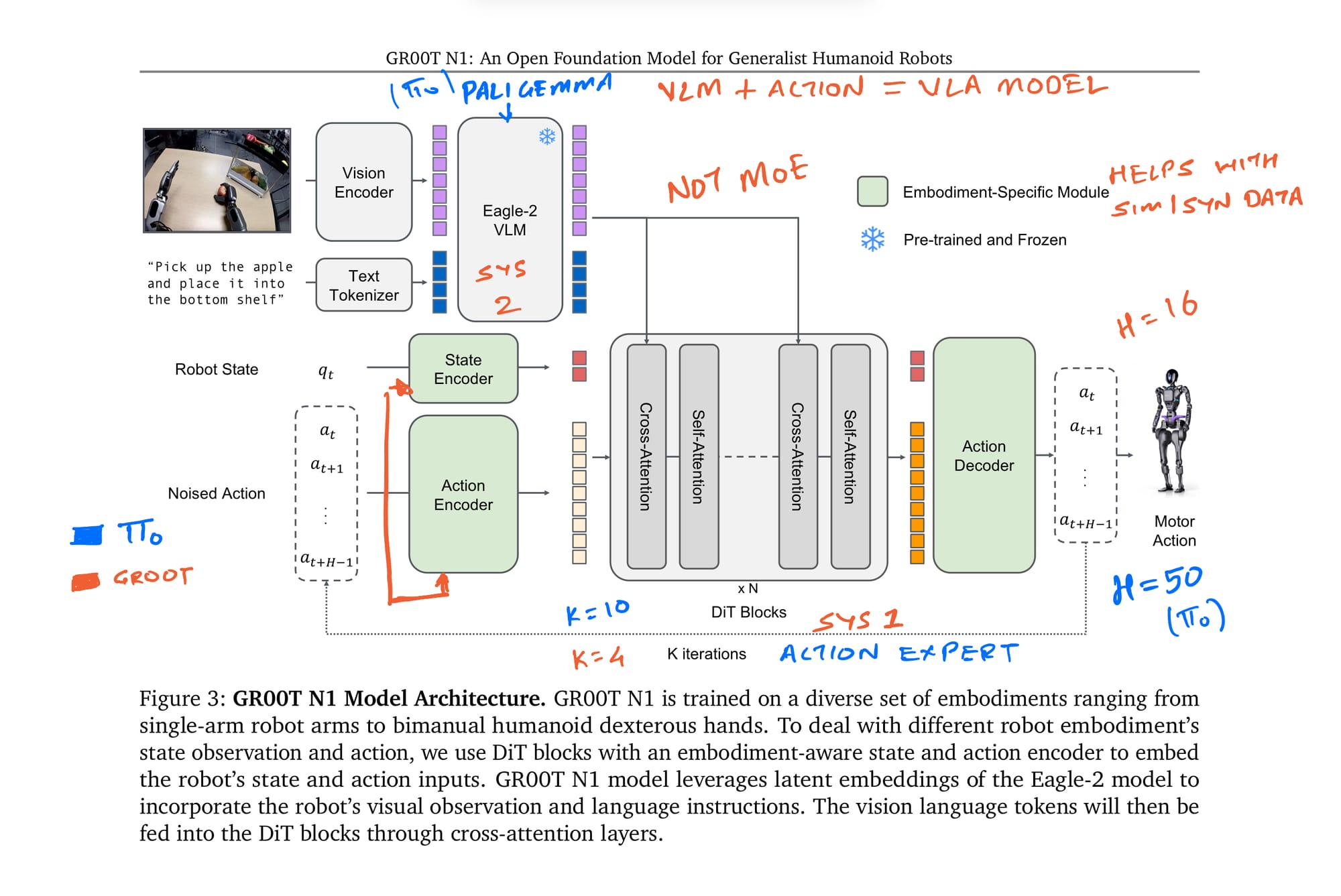
The deliberate, slow module is Eagle-2, NVIDIA's vision-language model. It reads the camera images and the language instruction and forms a semantic understanding of the scene: what objects are present, what the task is asking for. The key choice is what stays fixed. As the paper puts it, "we keep the language component of the VL backbone frozen and fine-tune the rest of the model": the language model is held frozen to preserve its pretrained world knowledge, while the vision encoder and the rest of the network are fine-tuned on robot data.
System 1: a diffusion transformer that produces motion
The fast, reflexive module is a Diffusion Transformer (DiT) trained with flow matching: it learns to denoise from a noise sample into a chunk of future actions, conditioned on the current state and on System 2's understanding. This is the same flow-matching DNA as π₀. The two systems are joined by cross-attention: the action module attends into the frozen VLM's features. (That is a deliberate contrast with π₀'s mixture-of-experts style of shared attention. Same family, different wiring.)
Adapters: one core, many bodies
Different robots have different joints, sensors, and action spaces, and human video has none of these at all. GR00T handles this with embodiment-specific state and action encoders and decoders, small adapter layers around the shared core. The same model can ingest a robot's proprioception and emit its joint targets, ingest a different robot, or treat human video as its own "virtual embodiment". This is what makes training on one heterogeneous mixture possible.
Two design choices: the action chunk and a detection loss
System 1 predicts an action chunk of length H = 16: sixteen future steps at once, then re-plan. (Compare π₀'s H = 50; in practice those longer chunks rarely ran to completion before re-planning, so a shorter chunk is lighter and often enough.) On top of the flow-matching objective, GR00T adds an auxiliary object-detection loss:
Freezing the VLM's language component is a data decision in disguise. That language model already knows what a coffee cup and a drawer are from internet-scale pretraining; the scarce robot data should not be spent re-teaching language and world knowledge. So GR00T pins the language model and lets the rest, the vision encoder and the action stack, adapt to the robot. The general knowledge stays intact while the parts that must learn the embodiment get to move.
03The data pyramid, and two ways to mine its base
Picture the training data as a pyramid. At the wide base: web and human video, vast, but with no action labels. In the middle: simulation, large and cheap to scale, generated with systems like DexMimicGen. At the scarce tip: real robot teleoperation, small and expensive, and the most valuable of all because it is the only layer that is unambiguously the robot doing the real task.
The whole game is to feed the model from the layers that have no actions. GR00T does it with two distinct tricks, which the next sections unpack: latent actions (read an abstract motion code off any video pair) and an inverse-dynamics model (invent concrete pseudo-actions for generated video). Together they let the abundant, label-free layers contribute real training signal, and let a sliver of real teleoperation be amplified into something an order of magnitude larger. Drag the slider below to feel that multiplier.
Real robot hours are the bottleneck, so do not try to collect your way out of it. Instead build machinery that extracts action signal from data that never had any, and machinery that generates more robot-like data than you could ever teleoperate. You buy your scale in GPU time, not in robot time.
04Trick 1, latent actions: a code for the motion, not the joints
Start with the hardest case: a human picking up a cup on video. You have no joint angles. Trying to regress the human's exact pose, or worse the robot joints that "would" produce it, is messy and probably impossible. So GR00T does not predict a concrete action at all. It predicts an abstract representation of the motion itself.
The mechanism is a VQ-VAE (vector-quantized autoencoder) trained over frame pairs. The encoder looks at frame $t$ and a future frame $t+H$ and emits a continuous embedding $e$ that captures the essence of the movement between them. That embedding is quantized to the nearest entry in a learned codebook of motion prototypes, and a decoder tries to reconstruct $t+H$ from frame $t$ plus the chosen code. Forcing the reconstruction to go through a small codebook is what structures the latent space into clean, reusable motion types.
The widget below is this encode-then-quantize step, run live. Set the motion you observe between the two frames (its direction and size). The encoder maps it to a point $e$ in a 2-D latent space; quantization snaps $e$ to the nearest of the codebook's motion prototypes; the decoder reconstructs the canonical end-pose for that prototype. Watch which prototype your motion lands on, and watch the quantization gap when your motion sits between two of them.
05Using latent actions: human video becomes a virtual robot
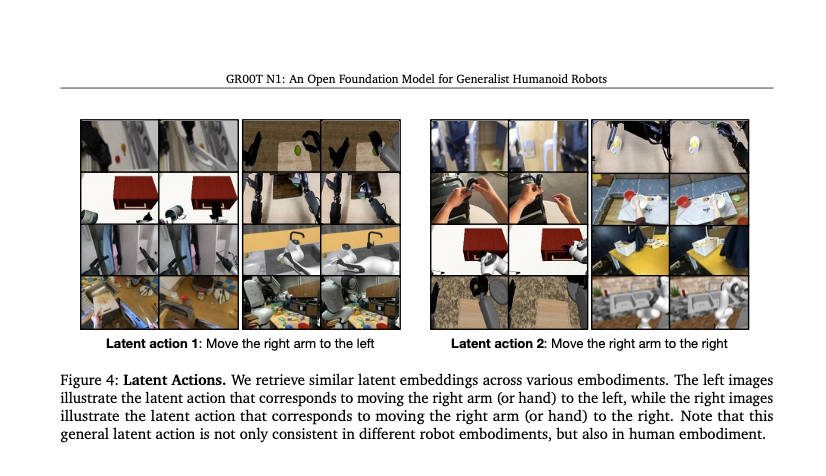
Here is the payoff. Once the VQ-VAE is trained, generating a training label for an action-less video is trivial: feed it the frame pair and read the continuous encoder output straight off. The codebook's only job was to structure the latent space cleanly during VQ-VAE training; the label fed to the policy is not the discrete code index but the continuous pre-quantization vector itself. That vector becomes the "latent action" for that clip. It is not joint angles; it is a point in a learned space that means something like "move the arm this way" or "grasp like that".
GR00T then trains its main policy to predict these continuous latent-action vectors for human-video inputs, treating human video as its own virtual embodiment, which the paper labels the "LAPA" embodiment after the Latent Action Pretraining method of Ye et al. (2025) that it borrows. The model learns general visual patterns and motion intentions from human video, without ever needing a single human pose label, and that knowledge transfers to the robot embodiments that share the same codebook.
It is the difference between transcribing a dance move-for-move in someone else's body geometry, which is hopeless across different bodies, and writing it in choreography notation: "step left, reach, turn". The notation is body-agnostic, so a dancer with completely different limbs can read it and perform the same intent. The latent action is that notation; LAPA is the dancer learning to read it before it ever has to perform with the real instrument.
Test yourself: why predict an abstract latent action for human video instead of regressing joint angles?
06Trick 2, the inverse-dynamics model: read the actions off two frames
Latent actions are perfect for video that is far from the robot's world, like arbitrary human clips. But for video that is close to the robot's world, in particular the generated "neural trajectories" we are about to make, GR00T can do something more direct: recover the actual action chunk.
The tool is an inverse-dynamics model (IDM). Train it on data where you do know the actions (real teleoperation): show it frame $t$ and frame $t+H$, and have it output the sequence of robot actions that occurred in between. NVIDIA trains this as a separate inverse-dynamics model on real action-labeled teleoperation. Once trained, point it at action-less video and it fills in the missing actions, manufacturing the pseudo-action labels GR00T trains on, for free.
The widget below is that inference. Set where the hand ends up at frame $t+H$; the IDM infers the per-step action chunk that carries the hand from start to end, and a marker marches along it while little bars show each step's motion. Then flip the input toggle from real to generated: the same IDM, pointed at a video that came with no action label, manufactures the chunk anyway. That flip is the whole trick.
07Neural trajectories: turning 88 hours into roughly 827
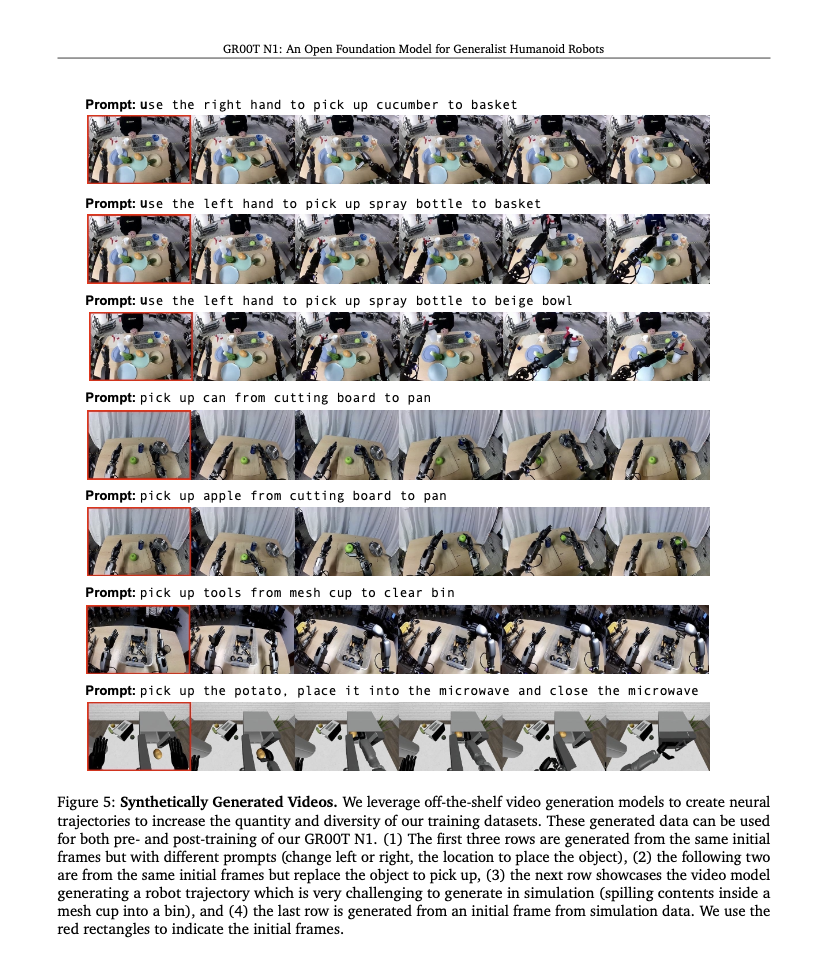
Now the two tricks combine into the headline result. GR00T fine-tunes a video generation model on the real robot teleoperation footage, so it learns to produce video that looks like this robot, in these scenes, doing these kinds of things. Then it prompts that generator into brand-new episodes: start from a real initial frame, hand it a fresh text prompt (auto-written by a prompting VLM) to vary the scenario, and generate a new clip. The paper reports generating 81-frame, 480p episodes this way. A separate VLM judge then does quality control, throwing out clips that do not match the prompt.
Each generated clip is action-less, so the IDM from the previous section labels it with pseudo-actions, and it becomes usable training data. The arithmetic of the whole pipeline is the punchline:
One honest caveat the author of the source notes flags from experience: this only works because the video generator is fine-tuned on real robot footage. Off-the-shelf, general-purpose video generation does not produce anything usable for robot training. The clip below is a generic Sora attempt, included precisely to show the gap: visually plausible in the abstract, useless as robot supervision. The whole point of "neural trajectories" is that you must specialize the generator first.
08Why generated video instead of more pure simulation
It is fair to ask: if you want more robot data, why generate video at all? Why not just run more physics simulation, which is cheaper per hour and gives you ground-truth actions directly? GR00T uses simulation too (DexMimicGen), but it leans on neural trajectories for two reasons that simulation struggles with.
Closer to the real visual domain
Because the video model is fine-tuned on real robot footage, its output carries the real appearance: lighting, textures, sensor quirks, the look of the actual lab. That is exactly the visual domain the policy will eventually be deployed in, so training on it should shrink the sim-to-real visual gap that a clean rendered simulation reopens.
Hard physics, captured implicitly
Some things are genuinely hard to simulate: pouring fluids, watering plants, folding cloth. A physics engine either fakes these expensively or not at all. A video model trained on countless real clips has implicitly seen how these phenomena look, so it can generate visually plausible sequences of them, sidestepping the simulation problem entirely (even though the model is not literally solving the physics).
None of this is free. Generating the roughly 827 hours of neural trajectories took about 105k L40 GPU-hours. That is real money, but it is plausibly cheaper and faster than physically teleoperating 800-plus hours of a humanoid. The trade is explicit: you buy data scale in GPU time instead of robot time.
Generated data inherits the generator's flaws. A video model can hallucinate physically impossible transitions, and the IDM will dutifully label them anyway, so the pseudo-actions are only as trustworthy as the clip and the VLM judge that screened it. Latent actions capture motion intent but discard exact dynamics, so they help with what to do, less with precise how. And the pipeline is heavy: a fine-tuned generator, a VLM prompter, a VLM judge, and an IDM all have to be built and trusted before a single neural trajectory exists.
09Where it fits, and the one-line takeaway
GR00T N1 shares π₀'s genetic material, a vision-language module plus a flow-matching action module, but it makes a different bet about where the leverage is. π₀ and its successors invest heavily in architecture and post-training recipe; GR00T invests in data manufacturing. The dual system, the cross-attention link, the embodiment adapters: all competent, none revolutionary. The revolution it is reaching for is being able to train on video that has no actions, at a scale teleoperation can never match.
That places it in a clear lineage: it carries the π₀ flow-matching family's architecture forward but, like the DreamGen / neural-trajectory line out of the same author group, treats the data problem as the real problem. Latent actions and the IDM are two complementary answers to the same question, "how do I get supervision out of a clip that came with none?", one abstract and body-agnostic, one concrete and robot-specific. Neural trajectories are the factory that turns a trickle of real data into a flood of synthetic data the IDM can label.
If you take one thing from GR00T N1, make it this: the headline number is not a benchmark score, it is 88 hours becoming about 827. Everything in the model serves that multiplication. When real data is the bottleneck, the highest-leverage research is often not a better network, it is a better way to make data.
The one-sentence takeaway: action-less video is the ocean, and GR00T N1's real contribution is two ways to drink from it, a latent-action code that reads motion intent off any frame pair and an inverse-dynamics model that invents the missing actions, so a fine-tuned video generator can turn 88 hours of real robot time into roughly 827 hours of trainable neural trajectories.